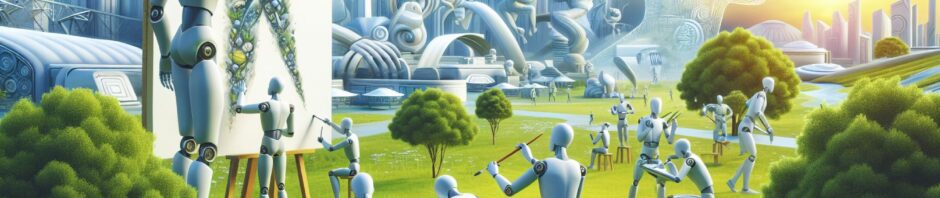
Hello, tech enthusiasts and dreamers alike! I hope you’re tuning in for yet another dive into the world of emerging technology, a space that’s full of possibilities that get me genuinely excited and sometimes a little overwhelmed. Today, I want to chat about a corner of the tech world that’s turning heads (and rightly so): AI in the artist’s studio. Can artificial intelligence actually tap into that spark of creativity that we think makes us human? Is this a blessing or something we should worry about? Let’s jump in and find out!
Birth of the Mechanical Muse
Remember when art was supposed to be that impossible-to-teach craft, something you either had or you didn’t? Well, the folks at places like OpenAI have completely upended that assumption by teaching machines to create music, pictures, and even poetry. Over time, AI moved beyond just following human commands to generating its own content. My initial reaction? Pure skepticism. The idea of a bunch of circuits outdoing Picasso made me cringe. I mean, could you imagine Van Gogh having a face-off with a server room?
Yet here they are. AI models analyzing thousands of classical works at lightning speed and somehow nailing a version of the strokes and rhythms that only the greatest museums usually hold. Programs like AIVA, Emily Howell, and DeepArt.io are making waves across what we used to think was purely human territory.
Artists’ Newest Frienemy?
That’s when I decided to try it myself. I asked an AI art tool to work with one of my amateur paintings, and instead of the disaster I expected, it gave me these surreal mountainscapes that looked like they came straight out of a fantasy novel.
The big question sits right here: is AI now art’s newest partner or its biggest threat? I’ve been thinking about this a lot, and honestly, it’s complicated. On one hand, I see established artists collaborating with AI, finding this sweet spot where human intuition meets algorithmic precision. But there’s also this underlying tension. Artists are worried about being replaced, about their authentic vision being reduced to something any algorithm can replicate.
What This Actually Means for Art
Let’s get real about what we’re seeing with today’s experimental art tools. AI can analyze patterns, mimic styles, and even combine influences in ways that surprise us. But when I look at a piece created entirely by AI, something feels different. It might be technically impressive, even beautiful, but there’s often this sense that something human is missing.
The question isn’t whether AI can make pretty pictures or catchy melodies. It can. The question is whether that’s the same thing as art that moves us, challenges us, or helps us see the world differently.
The Real Tension Here
What bothers me most isn’t the technology itself. It’s how quickly we seem ready to accept AI-generated content as equivalent to human creativity. I worry we’re losing sight of what makes art valuable in the first place. It’s not just about the end product. It’s about the human experience, the struggle, the perspective that goes into creating it.
At the same time, I can’t ignore how AI tools are helping artists explore new possibilities. They’re speeding up certain processes, helping with ideation, and opening doors to techniques that would be impossible manually. Maybe the future isn’t about AI replacing artists, but about artists learning to work with AI in ways that amplify their humanity rather than diminish it.
Where I Think This Goes
Honestly? I think we’re still figuring this out. The technology is moving faster than our ability to understand its implications. We’re going to see more AI-human collaborations, more debates about authenticity, and probably some amazing art that pushes boundaries in ways we haven’t imagined yet.
But I hope we don’t lose sight of why human creativity matters. The best art has always been about more than technical skill. It’s about perspective, emotion, and the uniquely human way of seeing the world. AI might be able to mimic that, but I don’t think it can replace it.
My Take
After spending time with these tools and thinking through the implications, I’m cautiously optimistic. AI in art isn’t going away, so we might as well figure out how to use it thoughtfully. The key is remembering that technology should enhance human creativity, not replace it.
What excites me most is the possibility that AI tools might democratize certain aspects of art creation, giving more people access to creative expression. What worries me is the potential for human perspective to get lost in the rush toward efficiency and novelty.
Alright, fellow tech enthusiasts, I hope you enjoyed this exploration of AI in the creative world! What do you think? Are you excited about the possibilities, worried about the implications, or somewhere in between?
Let me know what you think about where this technology is heading. I’d love to hear your perspective on this ongoing conversation about creativity, technology, and what makes art meaningful.