The Beautiful Mess of Almost-Projects

The Graveyard in My Desk Drawer

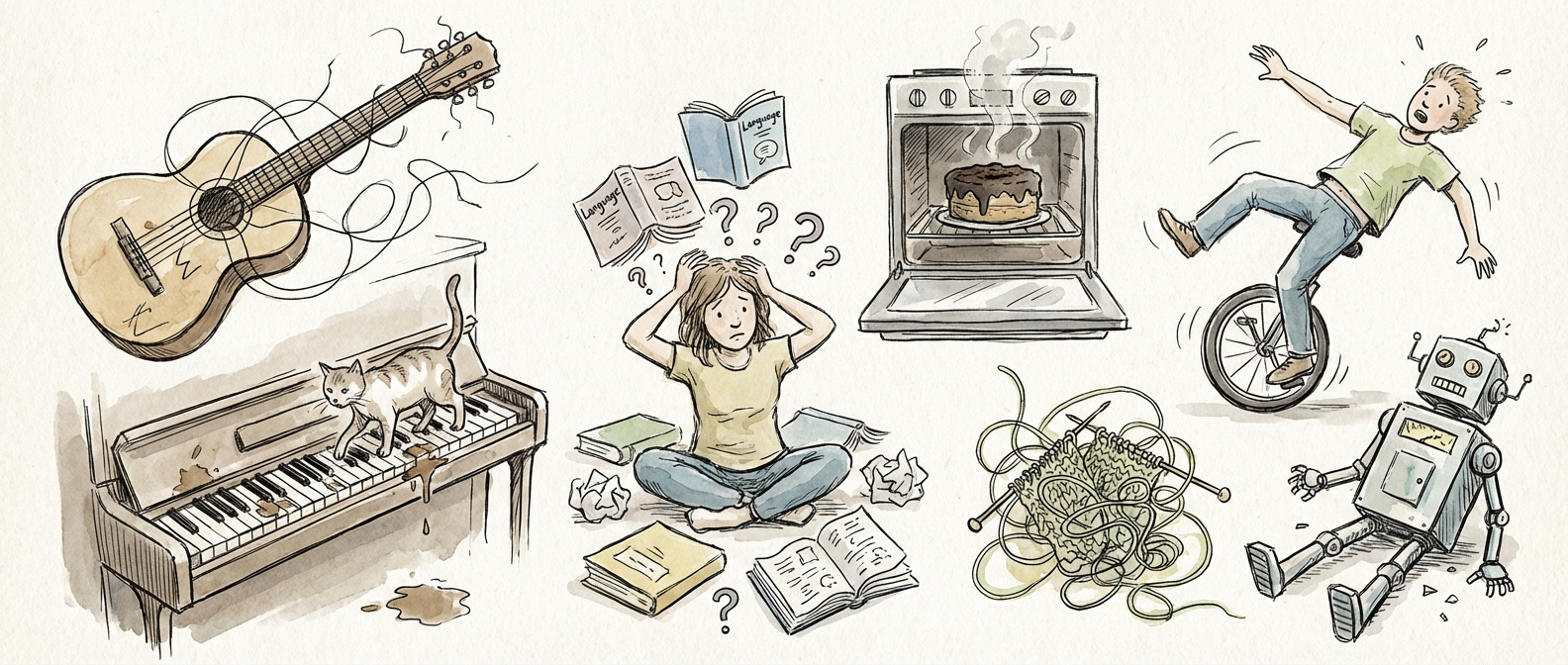
I opened my desk drawer this morning looking for a decent pen and found instead a small archaeological dig of creative ambition. Three half-filled notebooks with different handwriting experiments. A USB drive labeled “pottery videos” from when I was convinced I’d become a ceramicist. Seventeen sketches of the same houseplant from different angles, because apparently I thought the eighteenth would be the one that unlocked my hidden artistic genius.

There’s this weird shame that comes with creative false starts, isn’t there? Like each abandoned project is evidence of some character flaw, proof that we’re the kind of people who can’t see things through. But sitting there with my drawer archaeology spread across the desk, I started wondering if maybe we’ve got this all wrong. Maybe the graveyard isn’t the problem. Maybe it’s the whole point.

The pottery thing lasted exactly four YouTube videos and one disastrous attempt to center clay on a wheel I’d optimistically ordered online. The wheel now works as an excellent plant stand, which feels like a metaphor for something, though I’m not sure what. The notebooks are filled with story beginnings, fragments of ideas, and one surprisingly detailed plan for reorganizing my spice cabinet that I never implemented but somehow still reference when I’m cooking.

The Mythology of Finishing

We tell ourselves stories about successful people that just aren’t true. We imagine they’re the ones who always finish what they start, who have some magical ability to push through the messy middle of every creative endeavor. But the more I pay attention, the more I notice that most interesting people have their own version of my desk drawer. They just don’t talk about it at dinner parties.

My friend Sarah mentioned last week that she has seventeen unfinished quilting projects in various stages of completion. Seventeen. She said it like she was confessing to a crime, but when she described each one, her eyes lit up. The experimental color combinations she tried. The new techniques she learned on the third project that she applied to the seventh. The way she figured out her own style by working through what didn’t feel right.

I started thinking about how we learn to ride bikes. Nobody expects you to nail it on the first try. Wobbling is part of the process. Training wheels aren’t considered failure, they’re considered smart. But somewhere along the way, we develop this idea that creative work should be different, that starting something new means committing to some predetermined finish line.

The Laboratory Mindset

What if we treated creative experiments more like actual experiments? In science, negative results are still results. A hypothesis that doesn’t pan out isn’t a failed experiment, it’s data. It tells you something useful about the world, even if it’s not what you expected to learn.

I tried this mindset with my latest creative detour, a project involving learning to use my camera’s manual settings. Instead of setting out to become a photographer, I decided I was just going to figure out what aperture actually does. No pressure to produce anything meaningful, just curiosity about the mechanics. Turns out, when you remove the expectation of creating art, you accidentally create some interesting images. Or at least, you create images that teach you something about light.

The breakthrough came when I stopped trying to take good photos and started trying to take intentionally bad ones. I spent an afternoon deliberately overexposing everything, creating these washed-out, ethereal mistakes that somehow captured the feeling of that particular Tuesday better than any technically correct image could have. It wasn’t what I set out to learn, but it was definitely what I needed to learn.

Now I keep a section in my notebook labeled “experiments in progress” instead of “projects.” It’s a small semantic shift that somehow makes everything feel more possible. Experiments can be abandoned without shame. They can evolve into something completely different from what you started with. They can fail spectacularly and still teach you something valuable.

The Unexpected Connections

Here’s what nobody tells you about creative false starts: they’re not actually false. They’re just starts. And starts have a way of connecting to each other in ways you don’t see coming.

Those pottery videos I never finished watching? They taught me about centering and balance in ways that somehow improved my writing. The plant sketches that never turned into proper drawings helped me notice how light moves through my living room at different times of day, which led to rearranging my furniture in a way that makes the whole space feel more alive. The abandoned story fragments have become a library of characters and situations I pull from when I’m stuck on other writing projects.

My spice cabinet reorganization plan, the one I never implemented but still reference, has somehow become the template for how I approach any organizational challenge. I didn’t follow through on the original project, but the thinking I did while planning it changed how I think about systems and efficiency in general.

This is the thing about creative work that nobody mentions in the productivity blogs: it’s all connected. Every experiment, even the ones that fizzle out after three days, adds something to your internal creative database. You’re not starting from scratch each time. You’re building on all the previous experiments, even the ones that didn’t go anywhere obvious.

Embracing the Incomplete

I’m learning to see my desk drawer graveyard differently now. Instead of evidence of my inability to commit, it’s proof that I’m willing to try things. Each abandoned project represents a moment when curiosity overcame fear, when I chose to start something new instead of staying safe in familiar territory.

Maybe the goal isn’t to become the kind of person who finishes everything. Maybe the goal is to become the kind of person who starts interesting things, who follows curiosity down unexpected paths, who treats creative work like play instead of performance. Maybe the measure of a creative life isn’t how many projects you complete, but how many times you’re willing to begin.

I’m curious about your own creative archaeology. What’s lurking in your equivalent of my desk drawer? What experiments are you carrying around that feel like failures but might actually be foundation stones for something you haven’t imagined yet? I have a feeling we’re all more alike in this than we admit, and there’s something comforting about that shared landscape of beautiful, unfinished things.

Posted in Uncategorized | Comments Off on The Beautiful Mess of Almost-Projects

The Projects That Actually Matter (And Why I Keep a Messy Notebook About Them)

Why Some Work Actually Feels Like Work Worth Doing

I’ve been keeping what I call a “process notebook” for the past eight months, and it’s become this weird mirror that shows me which projects I actually give a damn about. Not the ones I’m supposed to care about, or the ones that look impressive on paper, but the ones that make me forget to check my phone for three hours straight.

The notebook started as an accident. I was working on a community garden mapping project and got frustrated trying to explain to my partner why I was spending my Saturday morning crouched in someone’s backyard, measuring raised beds with a tape measure that kept snapping back and hitting my thumb. So I started writing it down, not for any grand purpose, just to figure out what the hell I was doing and why it mattered to me.

What I discovered is that the projects I actually care about share this strange quality: they’re all slightly broken in ways that make them more interesting. The garden mapping thing? Half the community gardens don’t have official addresses, some exist in legal gray areas, and three of them are just “behind the blue house on Maple Street.” But that’s exactly what makes the project feel alive instead of bureaucratic.

The Difference Between Clean Problems and Real Problems

My day job involves a lot of what I’ve started calling “clean problems.” Clear scope, defined deliverables, stakeholders who know exactly what they want. These projects run on time, get approved without drama, and leave me feeling like I’ve successfully operated a very efficient machine that could have operated itself.

The projects in my notebook are messier. There’s the local history podcast where I’m trying to track down the story of why our town has seventeen different street names that all reference the same guy who apparently wasn’t even from here. Every interview leads to three more questions and two contradictory newspaper clippings from 1987. The research sprawls everywhere, leads nowhere definitive, and hooks me completely.

Or the project where I’m helping a friend document traditional recipes from his grandmother before she forgets them. Except it turns out she doesn’t really use recipes, just “a little of this” and “until it feels right,” and half her techniques involve reading the mood of her sixty-year-old oven. We’re basically trying to reverse-engineer decades of muscle memory, which is probably impossible and definitely worthwhile.

What My Notebook Actually Looks Like

I should clarify that this isn’t some beautiful, Instagram-worthy bullet journal situation. It’s a basic composition notebook with coffee rings and pages that curl at the edges because I keep leaving it places where it gets damp. The handwriting is terrible. I use whatever pen I can find, which means some entries are in blue ballpoint, others in pencil that’s barely legible, and one memorable week in purple gel pen that I immediately regretted.

But the content tells a story I couldn’t see while I was living it. There are sketches of garden layouts next to frustrated rants about permit applications. Phone numbers for people who might know something about the mysterious street-naming guy. Half-finished thoughts about why the recipe project feels important even though no one asked me to do it. Lists of what worked, what didn’t, and what I want to try next.

The notebook has taught me that I’m drawn to projects that sit right at the edge of things disappearing. Not preserving them in amber, but catching them before they slip away completely. The community gardens shift constantly as people move, budgets get cut, and neighborhoods change. The recipes live in this space between tradition and whatever happens when tradition meets a different kitchen, different ingredients, different hands. Even the street name thing is really about rescuing stories that get a little more garbled with each telling.

The Permission to Be Incomplete

One of the most liberating things about tracking these projects is seeing how much of the work is about not knowing things yet. The notebook is full of questions I haven’t answered, leads I haven’t followed up on, and experiments I want to try when I have time. Instead of feeling overwhelming, this incompleteness has become oddly comforting.

The garden mapping project will never be truly finished because the gardens themselves keep changing. New beds get built, old ones get abandoned, and people have different opinions about whether that patch of tomatoes behind the community center counts as part of the official garden or not. But this ongoing nature is part of what makes it feel alive and worth doing.

I’ve started thinking of these projects as conversations rather than assignments. The notebook captures not just what I’m doing, but how I’m thinking about what I’m doing, and why certain approaches feel right while others make me want to abandon the whole thing and reorganize my sock drawer instead.

What This Reveals About the Work That Matters

Looking back through eight months of scribbled entries, I can see patterns I wasn’t conscious of at the time. The projects I care about most are the ones where I’m not just executing someone else’s vision, but actively figuring out what the vision should be. They involve real people with real stakes in the outcome, not abstract concepts or theoretical improvements.

They’re also projects where the process teaches me something I didn’t expect to learn. Mapping gardens has taught me about urban planning, water rights, and the surprisingly complex politics of shared space. The recipe documentation has become a crash course in cultural preservation and the challenge of turning muscle memory into words. The street name research has revealed layers of local history that somehow never made it into any official records.

Maybe most importantly, these projects give me permission to care about things that seem small or niche to other people. Not everything has to scale or disrupt or change the world. Sometimes the most satisfying work is quietly useful to a handful of people who need exactly what you’re building.

I’m curious about your version of this. What projects make you lose track of time? What work feels worth doing even when it’s frustrating or unclear or slightly ridiculous? I’d love to hear about the things you’re working on that don’t fit neatly into job descriptions but somehow matter anyway.

Posted in Uncategorized | Comments Off on The Projects That Actually Matter (And Why I Keep a Messy Notebook About Them)

I Was Wrong About Smart Home Gadgets (And Other Tech That Actually Works)

The Great Smart Bulb Revelation

For years, I was that person rolling my eyes at smart home everything. The friend who’d visit your place and watch you fumble with three different apps just to turn on a lamp. “Just flip the switch,” I’d think, smugly superior in my analog simplicity. Then my partner got us a starter pack of smart bulbs for the bedroom, and I grudgingly agreed to try them for two weeks.

I Was Wrong About Smart Home Gadgets (And Other Tech That Actually Works)

That was eight months ago. Now I’m the person who dims the lights to 20% warm white at 9 PM without thinking about it. The person who realizes halfway to work that I can just check my phone to see if I left anything on. The conversion wasn’t dramatic, no lightning bolt moment. Just the slow recognition that some friction in my daily routine had simply disappeared.

The thing about being wrong is that it usually happens quietly. You don’t wake up one day and declare your previous self an idiot. Instead, you notice you’re reaching for your phone to adjust the bedroom lighting instead of stumbling around in the dark, and you think, “Huh. I guess this isn’t so ridiculous after all.”

Illustration for I Was Wrong About Smart Home Gadgets (And Other Tech That Actually Works)

When Calendars Started Making Sense

I used to be a notebook person. Bullet journals, paper planners, the whole aesthetic setup that looks great on Instagram but somehow never quite worked for real life. The problem wasn’t the system, it was me. I’d forget to write things down, lose track of which notebook I was using that week, or worse, remember I had something written down but have no idea where.

Digital calendars felt impersonal and overwhelming. All those notifications and color-coded categories seemed like productivity theater rather than actual help. But somewhere in the middle of 2023, I started putting everything in my phone’s default calendar app. Not because I had some grand revelation about digital organization, but because I was tired of missing things.

The shift happened when I realized the calendar wasn’t trying to optimize my life, it was just trying to remember things so I didn’t have to. Travel confirmations automatically populate from my email. Meeting links live right there in the event. Most importantly, it syncs with my partner’s calendar, so we both know when the other has that early morning call or late afternoon dentist appointment.

It’s not glamorous. There are no beautiful spreads to photograph or satisfying pen-to-paper moments. But I haven’t double-booked myself in months, and that’s worth more than any aesthetic points I was scoring with my paper planner.

The Surprising Usefulness of Voice Assistants

Let me be clear: I still think it’s weird to talk to a cylinder in my kitchen. The idea of having an always-listening device felt dystopian, and honestly, it still kind of does. But my housemate had one when I moved in, and I gradually discovered it’s actually useful for exactly three things.

First: timers while cooking. When your hands are covered in flour or raw chicken, being able to say “set timer for twelve minutes” without reaching for your phone is genuinely helpful. Second: unit conversions and basic math while following recipes. “How many tablespoons in three-quarters cup” gets answered instantly instead of requiring a Google search that somehow leads to reading about the history of measuring spoons.

Third, and this surprised me most: it’s become our household’s shared memory. “Add milk to the shopping list” works from anywhere in the apartment. “What did I tell you to remind me about tomorrow?” actually gets answered. It’s like having a very patient roommate who never forgets anything and doesn’t judge you for asking the same question twice.

I still cover it when we’re having sensitive conversations, and I’ll probably never be comfortable with the privacy implications. But I’ve stopped pretending it isn’t useful just because the concept makes me uneasy. Sometimes helpful technology comes wrapped in packages that feel complicated.

Password Managers: The Security Blanket I Didn’t Know I Needed

For someone who spent years using variations of the same password everywhere, trusting a piece of software to generate and remember completely random passwords felt backwards. What happens when the service goes down? What if I forget my master password? What if the company gets hacked and my entire digital life becomes vulnerable?

These weren’t unreasonable concerns, but they were keeping me stuck in a system that was objectively worse. I was using passwords I could remember, which meant they were simple enough for other people to guess. I was reusing them across multiple sites, which meant a breach anywhere could compromise everything. I was basically choosing familiar risk over unfamiliar security.

The switch happened gradually. I started by putting just a few accounts into a password manager, keeping my old system as backup. Slowly, I realized I was reaching for the manager first because it was actually easier than trying to remember which variation of my password I’d used for which site. The auto-fill feature meant I could use genuinely secure passwords without any extra mental effort.

Now I have no idea what most of my passwords are, and that feels like freedom rather than vulnerability. The cognitive load of managing dozens of login credentials has just vanished. When I need to access something, I open the app, authenticate once, and everything is there. The security is better, but the convenience is what made it stick.

Small Changes, Bigger Patterns

Looking back at these shifts, they all share something: I changed my mind not because someone convinced me with arguments, but because I gradually noticed the technology solving actual problems in my daily life. None of these tools transformed my existence or revolutionized my productivity. They just quietly made certain small frustrations disappear.

Maybe that’s what useful technology actually looks like. Not the flashy stuff that promises to change everything, but the boring solutions that work consistently in the background. The smart bulbs that eliminate the three-second annoyance of finding a light switch in the dark. The calendar that prevents the fifteen-minute panic when you realize you might have double-booked yourself.

I’m probably still wrong about plenty of other technology. There are probably tools I’m dismissing right now that I’ll be quietly adopting six months from now. That’s fine. Being wrong about technology isn’t a character flaw, it’s just part of figuring out what actually helps versus what just sounds impressive. What technology have you been skeptical about that turned out to be genuinely useful? I’m curious about the small solutions that snuck up on you when you weren’t looking.

Posted in Uncategorized | Comments Off on I Was Wrong About Smart Home Gadgets (And Other Tech That Actually Works)

The Books That Made Me Wrong About Everything (And Why I’m Grateful)

The Economics Textbook That Ruined Small Talk

I used to be the person who rolled their eyes at “economics explains everything” types. Then I picked up Tim Harford’s “The Undercover Economist” during a particularly boring layover in Denver. What started as airport reading turned into three hours of realizing I’d been thinking about incentives completely backward.

The chapter on coffee shop pricing broke my brain in the best way. I’d always assumed Starbucks charged high prices because they could get away with it. Turns out they’re actually charging for convenience and location, not coffee quality. Suddenly every complaint I’d ever made about overpriced lattes felt embarrassingly naive. The book didn’t make me love capitalism, but it did teach me to ask “what’s the real transaction happening here?” instead of just getting mad about prices.

When Fiction Taught Me More Than Facts

I spent most of my twenties convinced that reading fiction was basically intellectual junk food. Why wade through made-up stories when there was so much real knowledge to absorb? Then my sister forced “The Sympathizer” by Viet Thanh Nguyen into my hands after I made some embarrassingly simplistic comment about the Vietnam War.

The narrator is a North Vietnamese spy embedded with South Vietnamese refugees in America. Reading his internal monologue as he navigates loyalty, identity, and survival made me realize how much my understanding of that conflict had been shaped by American movies and textbooks written by American historians. The book didn’t give me new facts about Vietnam. It gave me a completely different framework for thinking about war, immigration, and what it means to belong somewhere.

I still read plenty of nonfiction, but I stopped treating novels like dessert. Sometimes the best way to understand how the world works is through someone’s imagined experience of it.

The Psychology Book That Made Me Stop Trusting Myself

“Thinking, Fast and Slow” should come with a warning label: “Will make you question every decision you’ve ever made.” Daniel Kahneman spent decades studying how our brains trick us into bad choices, and reading about his research felt like discovering I’d been walking around with a broken GPS my entire life.

The chapter on the availability heuristic hit especially hard. I realized I’d been making major life decisions based on whatever examples came to mind most easily, not what was actually most likely to happen. That time I almost didn’t take a job because I could vividly remember reading about someone who hated a similar role? Classic availability bias. Meanwhile, I completely ignored the dozen people I knew who were thriving in that field.

The book didn’t make me paranoid about my own thinking, but it did make me more curious about it. Now when I have a strong gut reaction to something, I try to figure out which cognitive shortcut my brain just took. Usually it’s wrong, but at least now I know to double-check.

The History That Wasn’t What I Expected

I picked up “The Warmth of Other Suns” by Isabel Wilkerson because everyone said it was important, not because I expected it to reshape how I thought about American geography. The book follows three people who left the South during the Great Migration, and Wilkerson traces how their individual choices helped create the demographic map we live with today.

I’d always thought of cities like Chicago and Detroit as naturally industrial, naturally diverse. Reading about Ida Mae Gladney leaving Mississippi sharecropping for Chicago, or George Starling fleeing Florida citrus groves for Harlem, made me realize that the racial and economic patterns I took for granted were actually the result of millions of individual decisions made under impossible circumstances.

The book changed how I see every city I visit now. Those neighborhood boundaries that seem so natural? Someone drew them, usually for reasons that had nothing to do with geography and everything to do with who was allowed to live where.

Why Being Wrong Feels Like Winning

These books didn’t just add information to my existing worldview. They made me rebuild it from scratch, and that process turned out to be weirdly addictive. There’s something satisfying about discovering you were wrong about something fundamental. It means the world is more interesting than you thought.

I used to worry that changing my mind too often made me look inconsistent or wishy-washy. Now I think the opposite is true. The people who never update their beliefs aren’t principled, they’re just not paying attention. The world keeps teaching us new things, but only if we’re willing to admit we might have gotten something wrong the first time around.

What’s the last book that completely changed how you think about something? I’m always looking for my next intellectual plot twist.

Posted in Uncategorized | Comments Off on The Books That Made Me Wrong About Everything (And Why I’m Grateful)

The Small Things That Keep Me Tethered

Morning Coffee as Meditation

I’ve been making my coffee the same way for three years now, and I’m starting to think it might be the most important fifteen minutes of my day. Not because the coffee is particularly special – it’s just whatever’s on sale at the grocery store – but because of what happens in the space between grinding the beans and taking that first sip.

There’s this moment when I’m waiting for the water to boil where I just stand there. No phone, no mental to-do list running, just the sound of the kettle building toward its whistle. I used to fill this time with productivity – checking emails, planning my day, mentally reorganizing my closet. But somewhere along the way, I stopped. Now I just wait, and it feels revolutionary in the most ordinary way possible.

The ritual isn’t about the coffee, really. It’s about creating a pocket of time that belongs only to the present moment. When I pour the water over the grounds and watch them bloom, I’m not thinking about the meeting at ten or the grocery list on the counter. I’m just here, watching coffee happen. It sounds simple because it is, and maybe that’s exactly why it works.

The Evening Inventory

Every night before I brush my teeth, I do this thing where I mentally catalog three specific moments from the day. Not the big stuff – not accomplishments or failures or dramatic revelations – but the tiny details that caught my attention. The way afternoon light hit the kitchen wall. The sound of my neighbor’s dog barking at precisely nothing. The texture of a particularly good piece of bread at lunch.

I started this accidentally after reading somewhere that gratitude practices were supposed to make you happier. But when I tried the standard “three things I’m grateful for” approach, it felt forced and generic. My brain would default to “health, family, roof over my head” – true but not particularly connecting. So I shifted to noticing instead of evaluating, and something clicked.

What I’ve discovered is that this small act of deliberate remembering changes how I move through my days. I find myself paying attention differently, collecting small observations like souvenirs. It’s made me realize how much I usually miss when I’m operating on autopilot. The practice has turned me into a better noticer, which feels like an undervalued skill in a world that rewards speed over attention.

Walking Without Destination

Three times a week, I take what I call “nowhere walks” – twenty-minute loops through my neighborhood with no agenda except to move my body and let my mind wander. I don’t listen to podcasts or music. I don’t use the time for phone calls or problem-solving. I just walk and see what happens in my head.

These walks have become my most reliable source of clarity, though not in the way I expected. I thought they’d help me solve problems or generate brilliant ideas, and sometimes they do. But more often, they just help me sort through the mental clutter that accumulates throughout the day. It’s like my brain uses the rhythm of walking to file things properly – putting worries in perspective, bubbling up forgotten tasks, making space for whatever comes next.

The route I take has become familiar enough that I don’t have to think about navigation, which frees up mental bandwidth for everything else. I know which house has the garden that changes with the seasons, which corner always smells like someone’s dryer vent, which stretch of sidewalk catches the best light in the afternoon. This familiarity creates a kind of mental safety net that lets my thoughts roam freely without getting lost.

Sunday Reset Ritual

Sunday afternoons have become sacred time in my house, dedicated to what I call “gentle preparation.” It’s not about productivity or optimization – it’s about creating a sense of readiness for the week ahead without the stress that usually comes with planning. I make a pot of tea, sit down with a notebook, and spend an hour gently organizing my thoughts.

This isn’t about creating elaborate to-do lists or meal planning every detail. Instead, I check in with myself about what the coming week might need from me. Do I have any particularly challenging days ahead? What can I do now to make Tuesday easier? Is there anything I’ve been avoiding that I could tackle while I feel calm and centered?

The magic happens in the tone of this conversation with myself. Instead of demanding or pushing, I approach the week ahead with curiosity and kindness. I might prep a few meals, tidy up spaces that will matter when I’m rushed, or simply acknowledge that Wednesday looks overwhelming and give myself permission to keep expectations low that day. It’s planning without the anxiety, preparation without the pressure.

The Ongoing Experiment

Here’s what I’m still figuring out: whether these rituals work because of what they are, or because of what they’re not. They’re not complicated or Instagram-worthy or based on anyone else’s productivity system. They don’t require special equipment or perfect conditions. They’re just small, consistent ways of paying attention to my own rhythms and needs.

I’m curious about what small rituals ground other people, especially the ones that might seem unremarkable from the outside. There’s something powerful about practices that don’t announce themselves, that work quietly in the background of daily life. What are the tiny things that create stability in your days? What small consistencies have you built that you might not even think of as rituals? I’d love to hear what keeps you tethered – the ordinary magic that makes life feel more manageable, one small moment at a time.

Posted in Uncategorized | Comments Off on The Small Things That Keep Me Tethered

The People Who Rewired My Brain This Year (And Why I’m Still Processing It)

The Barista Who Made Me Rethink Efficiency

There’s this coffee shop on Fifth Street where the barista moves like he’s underwater. Marcus, I think his name is. Every morning I’d watch him take what felt like seventeen minutes to make a simple latte, and every morning I’d feel that familiar itch of impatience crawling up my spine. This is a guy who cleans the steam wand between every single drink, who examines each cup like he’s checking for microscopic flaws, who somehow turns the simple act of pouring milk into performance art.

I finally asked him about it one Tuesday when the line was particularly long and everyone was doing that thing where they check their phones aggressively. He looked at me like I’d asked him to explain quantum physics. “Why would I rush something I’m going to do a thousand times?” he said, then went back to his methodical routine. It was such a simple statement, but it hit different. I’d been treating efficiency like a religion, measuring every task by how quickly I could check it off a list.

Now when I catch myself rushing through something I actually care about, I think about Marcus and his deliberate hands. It’s not that I’ve become slow or precious about everything. It’s more like I’ve started asking myself which parts of my day deserve the underwater treatment and which parts can stay in the shallow end. Turns out, more things deserve the deep water than I thought.

My Neighbor’s Grandmother and the Art of Strategic Silence

Mrs. Chen sits on her front porch every afternoon at 3:47 PM. I know this because I’ve been working from home long enough to recognize the patterns in my neighborhood, and Mrs. Chen’s timing is more reliable than the mail truck. She’s ninety-three, speaks maybe twenty words of English, and has somehow become one of the most influential people in my year without us ever having a real conversation.

What gets me is how she listens. When her grandson comes by after school, bouncing with eight-year-old energy and stories that tumble over each other, she doesn’t interrupt or redirect or offer solutions. She just sits there, completely present, occasionally nodding or making these small sounds that somehow convey more than most people manage with full sentences. The kid talks for twenty minutes straight sometimes, and she absorbs every word like she’s collecting rare coins.

I started paying attention to my own listening habits after watching them together for months. Turns out I’m terrible at it. I’m always waiting for my turn to speak, or thinking about what I’m going to say next, or trying to relate everything back to my own experience. Mrs. Chen taught me that sometimes the most generous thing you can offer someone is your complete attention, no additions required. It’s harder than it sounds, this business of not filling every pause with your own voice.

The Accountant Who Collects Moments

I met Jennifer at a work conference in March, one of those soul-crushing events where everyone talks about synergy and paradigm shifts with straight faces. She was sitting alone at lunch, taking pictures of her sandwich with the kind of focus usually reserved for newborns or sunsets. Not Instagram pictures, mind you. These were going straight into what she called her “ordinary moments” album on her phone.

She explained it to me like this: most people document the big stuff, the vacations and celebrations and milestones. But she’d started collecting the regular Tuesday afternoon moments, the way light hits her kitchen counter, the expression on her cat’s face when it’s pretending not to care about treats. “The extraordinary stuff takes care of itself,” she said, showing me a photo of her coffee cup casting a shadow on her desk. “It’s the regular stuff that disappears if you don’t pay attention.”

I thought about this for weeks after the conference. How much of my life just evaporates because I’m waiting for something worth remembering to happen. Jennifer made me realize that most of life is actually made up of these unremarkable moments, and if you don’t find a way to notice them, you end up with a pretty empty collection. I haven’t started photographing my lunch, but I have started paying attention to the weight of my coffee mug in the morning, the sound my keys make when I drop them on the counter, the particular quality of light at 4 PM in winter.

The Customer Service Representative Who Changed My Relationship with Problems

Three months ago, my internet decided to die during the most inconvenient week possible. After forty-seven minutes on hold and two transfers, I got connected to David, who had the kind of voice that suggests he’s smiled at least once in his life. Instead of launching into the usual script about turning things off and on again, he said something that stopped me mid-rant: “Sounds like you’re having a real day.”

That’s it. Five words. But something about the way he said it, like he genuinely understood that this wasn’t just about internet connectivity but about the way small problems can feel enormous when they land on top of everything else. He fixed the technical issue in about ten minutes, but what stuck with me was how he treated the frustration as valid instead of something to be managed or dismissed.

I’ve been thinking about this approach ever since. How often do I treat other people’s problems like inconveniences to be solved rather than experiences to be acknowledged? David showed me there’s a difference between helping someone and actually seeing them. It’s the difference between fixing and witnessing, and apparently I’d been spending most of my time in fixing mode without realizing how exhausting that is for everyone involved.

What These People Have in Common

Looking back at these interactions, I’m struck by how none of them involved grand gestures or life-changing advice. They were all small moments that happened to land on fertile ground, the kind of encounters that could have easily passed without notice if I hadn’t been paying attention. Marcus with his deliberate coffee rituals, Mrs. Chen with her generous silence, Jennifer with her ordinary moment collection, David with his simple acknowledgment of hard days.

What they all shared was a certain quality of presence, a way of being fully where they were instead of rushing toward whatever came next. It’s made me more curious about the people I encounter in passing, more willing to slow down long enough to actually see them. Because apparently influence doesn’t always announce itself with fanfare. Sometimes it just sits quietly on a front porch or takes an extra minute with the steam wand, waiting for someone to notice.

Posted in Uncategorized | Comments Off on The People Who Rewired My Brain This Year (And Why I’m Still Processing It)

The Things I’m Learning Badly (And Why That Might Be the Point)

My Guitar is Judging Me

There’s a guitar in my living room that I swear has developed a passive-aggressive personality. It sits there, gathering dust between my sporadic practice sessions, practically radiating disappointment. I bought it six months ago with the kind of optimism reserved for New Year’s resolutions and midnight Amazon purchases. The plan was simple: fifteen minutes a day, maybe learn some Bob Dylan, become the person who casually pulls out an acoustic at parties.

The Things I'm Learning Badly (And Why That Might Be the Point)
The Things I’m Learning Badly (And Why That Might Be the Point)

Instead, I’ve mastered exactly one and a half chords. The G chord is my nemesis, requiring finger contortions that seem to defy basic human anatomy. My calluses are pathetic. My timing makes a broken metronome seem rhythmically gifted. And yet, I keep coming back to it, fumbling through the same basic progressions with the persistence of someone who clearly hasn’t gotten the memo that they’re terrible at this.

Here’s the thing though: I’m starting to think terrible might be exactly where I need to be. We live in a world obsessed with optimization, with life hacks and efficient learning and being good at things quickly. But what if the point isn’t to be good? What if the point is to be magnificently, persistently bad at something you love anyway?

Illustration for The Things I'm Learning Badly (And Why That Might Be the Point)
Illustration for The Things I’m Learning Badly (And Why That Might Be the Point)

The Myth of Natural Talent

I used to believe in natural talent the way some people believe in horoscopes. It explained everything so neatly: why some people effortlessly picked up instruments while others (me) sounded like they were torturing small animals. It was a comforting excuse that let me off the hook for not trying harder or sticking with things long enough to push through the inevitable wall of incompetence.

But then I started paying attention to the people around me who were genuinely good at things. My neighbor who makes pottery that belongs in galleries didn’t emerge from the womb throwing perfect bowls. She spent two years making what she generously calls “expensive paperweights.” My friend who runs marathons started by wheezing through a quarter-mile jog around the block. The pattern was always the same: they were willing to be bad for longer than everyone else was willing to watch.

The uncomfortable truth? We’ve convinced ourselves that being naturally gifted makes you worthy of pursuing something. As if the universe has pre-selected who gets to play music or paint or write poetry, and the rest of us should stick to our assigned lanes. This is nonsense, but it’s seductive nonsense because it saves us from the vulnerability that comes with genuine effort.

The Beautiful Awkwardness of Beginning

There’s something almost sacred about being truly terrible at something you care about. It strips away all pretense, all the careful image management we do in other areas of our lives. When I’m struggling to transition from C to F without creating what sounds like a minor earthquake, I can’t hide behind competence or experience. I’m just a person with slightly sore fingertips, trying to make something beautiful happen against all available evidence.

This vulnerability is both terrifying and liberating. In my professional life, I’ve built a reputation for being competent, reliable, someone who knows what they’re doing. But competence can become a prison. It keeps you in the safe zone, doing the things you already know how to do well. Being genuinely bad at guitar reminds me what it feels like to be a beginner, to have no choice but to embrace the messiness of not knowing.

Last week, I managed to play through “Wonderwall” almost completely. Almost. It was probably barely recognizable to anyone who knows the actual song, but for about three minutes, I felt like I was touching something larger than myself. That’s the thing about learning badly: small victories hit different when they’re hard-won through genuine struggle rather than natural ability.

The Productivity Trap

Our culture has turned everything into a productivity challenge. Learn Spanish in 30 days! Master photography with this one weird trick! Get ripped with seven-minute workouts! We’ve gamified skill acquisition to the point where the journey itself has become secondary to the destination. But what gets lost in this rush toward competence is the actual experience of learning.

I’ve tried the efficient guitar learning apps, the structured lesson plans, the promise of rapid improvement. They all felt like trying to microwave a slow-cooked meal. Technically possible, maybe, but something essential gets lost in the translation. The apps don’t account for the meditative quality of repetitive practice, or the way muscle memory develops through patient repetition, or the strange satisfaction of gradually earning each small improvement.

When I let go of the timeline, when I stopped measuring my progress against YouTube tutorials promising I’d be “playing like a pro” in impossible timeframes, something shifted. The guitar stopped being a test I was failing and became a conversation I was slowly learning to have. Some days the conversation is stilted and awkward. Other days, for brief moments, it almost sounds like music.

Learning to Love the Process

Maybe the real skill I’m developing isn’t playing guitar at all. Maybe it’s learning how to stick with something while being obviously, objectively bad at it. Maybe it’s developing patience with my own limitations. Maybe it’s remembering what it feels like to do something purely for the joy of doing it, rather than for any external validation or achievement.

There’s a Japanese concept called “wabi-sabi” that finds beauty in imperfection and impermanence. My guitar playing is definitely imperfect, and at my current rate of improvement, any actual competence feels pretty impermanent too. But there’s something beautiful about showing up anyway, about being willing to sound terrible in service of something you love.

The guitar still sits in my living room, still probably judging me. But these days, I think I’m judging it right back. We’re both imperfect, both a little worn around the edges, both trying to figure out how to make beautiful sounds together. Some days we succeed. Most days we don’t. But we keep showing up, and maybe that’s the point.

What are you learning badly these days? I’d love to hear about your own magnificent failures and small victories. Sometimes the best conversations happen in the spaces between competence and aspiration, where we’re all just figuring it out as we go.

Posted in Uncategorized | Comments Off on The Things I’m Learning Badly (And Why That Might Be the Point)

Books That Rewired My Brain (And Maybe Yours Too)

The One That Made Me Stop Pretending to Be Smart

I used to be one of those people who collected books like trophies. You know the type—shelves full of impressive spines that mostly went unread while I convinced myself that owning “Ulysses” made me intellectually sophisticated. Then I picked up “A Guide to the Good Life” by William Irvine, expecting some light philosophy to pad my resume of cultural consumption.

Books That Rewired My Brain (And Maybe Yours Too)

Instead, it completely dismantled my approach to, well, everything. Irvine writes about Stoicism without the usual academic stuffiness. Around chapter three, I realized I’d been performing intelligence instead of actually thinking. The book doesn’t just explain Stoic principles. It walks you through practical exercises that made me confront how much energy I was wasting on things I couldn’t control.

The shift wasn’t dramatic or Instagram-worthy. I just started noticing when my mind spiraled into worst-case scenarios about work deadlines or whether that text message sounded too eager. I’d catch myself and think, “Is this something I can actually influence?” Most of the time, the answer was no, and that tiny pause became a kind of mental reset button I didn’t know I needed.

Illustration for Books That Rewired My Brain (And Maybe Yours Too)

When Fiction Made More Sense Than Reality

“The Left Hand of Darkness” by Ursula K. Le Guin landed in my hands during a particularly confusing period when I was questioning everything about relationships and identity. I thought I was picking up a science fiction novel. What I got was a master class in how gender shapes every interaction we have, told through the story of an envoy visiting a planet where people are ambisexual.

Le Guin doesn’t hit you over the head with her ideas. Instead, she builds this world where pronouns shift and assumptions crumble, and you find yourself examining your own biases without realizing it’s happening. I remember sitting in a coffee shop, three chapters in, suddenly aware of how differently I was interpreting the barista’s friendliness based on assumptions I didn’t even know I was making.

The book taught me that imagination isn’t just about escapism. It’s a tool for understanding reality from angles we’d never consider otherwise. I started paying attention to the stories I told myself about people, situations, even my own limitations. Most of them, I discovered, were pretty unreliable narrators.

The Uncomfortable Mirror of Everyday Cruelty

I almost put down “The Banality of Evil” by Hannah Arendt twice. Not because it was boring, but because it was making me deeply uncomfortable about human nature, specifically my own. Arendt’s analysis of Adolf Eichmann’s trial reveals how ordinary people become complicit in monstrous systems, not through malicious intent but through thoughtlessness.

This wasn’t a distant historical lesson. I started recognizing my own capacity for what Arendt calls “thoughtlessness,” going along with things that felt wrong because it was easier than questioning them. The times I’d stayed quiet during conversations that made others uncomfortable. The systems I participated in without examining their impact. The small compromises that seemed insignificant individually but added up to something I wasn’t proud of.

The book didn’t make me paranoid or self-flagellating. Instead, it made me more intentional about the choices I make when no one’s watching. It’s exhausting sometimes, this heightened awareness of complicity, but I’d rather be tired than unconscious.

Learning to Sit with Not Knowing

“The Tao of Physics” by Fritjof Capra probably sounds like the kind of book that belongs on a college dorm room shelf next to a lava lamp, but hear me out. Capra, a theoretical physicist, draws parallels between modern physics and Eastern mysticism, and reading it felt like someone had given me permission to be confused by the universe.

I’d always been uncomfortable with uncertainty, the kind of person who needed definitive answers and clear explanations. But Capra walks you through quantum mechanics and Buddhist philosophy with this gentle insistence that mystery isn’t a problem to be solved. It’s a reality to be experienced. The idea that particles can exist in multiple states simultaneously until observed started to feel less like a physics concept and more like a life philosophy.

Now when I don’t know what I think about something, I try to sit with that uncertainty instead of rushing to form an opinion. It’s made conversations more interesting and decisions less anxiety-provoking. I’m still figuring out what I believe about most things, and apparently, that’s exactly where I’m supposed to be.

The Ongoing Experiment

These books didn’t fix me or provide some dramatic before-and-after transformation. They just shifted something subtle but significant in how I move through the world. I notice more, assume less, and question the stories I tell myself about pretty much everything. Some days I forget these lessons entirely and revert to old patterns of thinking. Other days, something clicks and I remember why perspective matters so much.

I’m curious about the books that have quietly rewired your thinking. Not the ones you’re supposed to say changed your life, but the unexpected ones that shifted something you couldn’t even name until later. The ones that made you see familiar things differently or question assumptions you didn’t know you held. What’s sitting on your shelf right now, waiting to surprise you?

Posted in Uncategorized | Comments Off on Books That Rewired My Brain (And Maybe Yours Too)

The Things I Stopped Doing This Year (And Why That Matters)

The Morning Productivity Theater

I used to wake up at 5:30 AM every single day, convinced that early rising was the secret sauce of successful people everywhere. There I’d be, bleary-eyed and resentful, forcing myself through a morning routine that felt like performance art nobody asked for. Meditation app open, journal ready, workout clothes laid out the night before like some kind of aspirational shrine.

The Things I Stopped Doing This Year (And Why That Matters)

The thing is, I’m not a morning person. Never have been. My brain doesn’t fully come online until around 10 AM, and trying to force it awake with artificial enthusiasm was like trying to start a car with a dead battery. Lots of noise, zero forward motion. I spent months feeling like I was failing at the basic act of being alive because I couldn’t sustain this routine that worked for exactly none of my actual rhythms.

Somewhere around March, I just stopped. Not the getting up part (unfortunately, jobs still require your physical presence at reasonable hours), but the elaborate morning ceremony. Now I wake up when my body wants to wake up, drink coffee like a normal human being, and save the deep thinking for when my brain actually wants to participate. Revolutionary stuff, really.

Chasing Every Networking Opportunity

Remember when everyone decided networking was the answer to everything? I sure do. I spent the better part of two years showing up to every professional meetup, industry mixer, and “coffee chat” that crossed my path. I collected business cards like they were Pokemon cards, had conversations that felt like elaborate performance pieces about mutual professional admiration, and came home exhausted from trying to be the version of myself that seemed most likely to advance my career.

The breaking point came at a particularly soul-crushing event where I found myself nodding enthusiastically at someone’s pitch for a blockchain-based dog walking app. Not because I thought it was brilliant, but because I’d trained myself to find something positive to say about everything, just in case this person might be useful later. That’s when I realized I’d turned networking into its own weird form of social media. All surface-level engagement and strategic positioning, zero authentic connection.

These days, I’m much more selective. I go to things that actually interest me, talk to people I genuinely want to talk to, and if something professionally beneficial comes out of it, great. If not, at least I didn’t spend an evening pretending to care about synergy and disruption. My career hasn’t collapsed from this approach, which tells you something about how necessary all that networking theater actually was.

Maintaining Friendships Out of Obligation

This one’s harder to talk about because it sounds callous when you say it out loud. But this year I stopped forcing relationships that had naturally run their course. Not the friendships going through rough patches or the ones requiring extra effort during difficult times. Those are worth fighting for. I’m talking about the relationships that had quietly shifted from genuine connection to social maintenance, where every interaction felt like going through the motions of a friendship rather than actually having one.

You know what I mean. The group chats that feel like obligation, the birthday dinners where everyone’s checking their phones, the friends who only surface when they need something or want to complain about the same problems they’ve been complaining about for years without any intention of changing anything. The relationships that leave you feeling drained rather than energized, where you find yourself making excuses to avoid hanging out.

It’s not about cutting people off dramatically or making grand statements. It’s about recognizing when you’re both just going through the motions and having the grace to let the friendship evolve into whatever it naturally wants to become. Sometimes that’s an occasional text exchange. Sometimes it’s nothing at all. Both can be okay.

Optimizing Everything

I used to track everything. Steps, calories, screen time, productivity metrics, reading goals, how many glasses of water I drank, which route to work saved the most time, whether listening to podcasts at 1.5x speed actually improved my learning retention. I had spreadsheets for my spreadsheets. I turned my entire life into a continuous improvement project, as if I were a small business trying to increase efficiency quarter over quarter.

The absurdity reached its peak when I found myself timing how long it took to make different breakfast options so I could optimize my morning routine. That’s when I realized I’d lost the plot entirely. I wasn’t optimizing my life, I was optimizing the life out of my life. Every moment had become data to be analyzed rather than experience to be lived.

Now I track almost nothing, and somehow I’m not less healthy or productive or informed. Turns out most of that optimization was just anxiety wearing a productivity costume. I still pay attention to patterns and try to make good choices, but I do it the way humans did before we had apps for everything: by noticing how I feel and adjusting accordingly.

The Quiet Revolution of Subtraction

Here’s what nobody tells you about stopping things: it’s harder than starting them. Starting feels productive, proactive, like you’re taking control. Stopping feels like giving up, even when the thing you’re stopping was making you miserable. We’re so conditioned to believe that more equals better that the radical act of less feels like failure.

But this year taught me that sometimes the most powerful thing you can do is nothing. Not starting a new routine, not taking on another project, not saying yes to every opportunity that presents itself. Just existing in the space you’ve already carved out and seeing what happens when you’re not constantly trying to improve it.

I’m curious about what you’ve stopped doing lately, and whether it felt like quitting or like finally coming up for air. There’s something comforting about realizing other people are also quietly opting out of things that don’t serve them, even when those things look perfectly reasonable from the outside.

Posted in Uncategorized | Comments Off on The Things I Stopped Doing This Year (And Why That Matters)

Your Creative Failures Are More Interesting Than Your Successes

The Pottery Wheel Humbled Me

Last month I signed up for a pottery class because Instagram convinced me I had hidden ceramic talents. You know how it goes – you see those satisfying videos of clay spinning into perfect bowls, and suddenly you’re convinced you’re one YouTube tutorial away from opening an Etsy shop. Three weeks and forty-seven dollars later, I had produced exactly one recognizable object: a lopsided mug that holds about three sips of coffee and tips over if you look at it wrong.

Your Creative Failures Are More Interesting Than Your Successes

Here’s the thing though, that wonky mug tells me more about creativity than any of my actual successes ever have. It sits on my kitchen counter now, a daily reminder that the distance between vision and execution is where all the interesting stuff happens. Every time I use it (carefully, very carefully), I remember the specific moment when I realized my hands weren’t cooperating with my brain, and how that felt both frustrating and oddly liberating.

We’ve gotten really good at hiding our creative failures, haven’t we? Social media has trained us to document the highlight reel, the finished painting, the published story, the perfectly plated dinner. But what about the painting you scraped off the canvas three times? The story that sits in your drafts folder, stubbornly refusing to make sense? The dinner that looked like abstract art in all the wrong ways?

Illustration for Your Creative Failures Are More Interesting Than Your Successes

Failure Is Where the Learning Lives

I’ve been keeping a failure journal for six months now. Not because I’m a masochist, but because I noticed something: my biggest creative breakthroughs always seemed to happen right after my most spectacular flops. The journal started as a way to track patterns, and it’s turned into something unexpected, a record of everything I’m brave enough to try badly.

Last Tuesday’s entry: “Attempted to write a short story from the perspective of my houseplant. Made it two paragraphs before realizing plants don’t have opinions about Netflix shows. Also, apparently I know nothing about plant biology.” Two days later, that ridiculous experiment led to a poem about anthropomorphizing objects that actually works. The failure wasn’t a detour. It was the route.

This runs counter to everything we’re taught about productivity and success. We’re supposed to fail fast and iterate, sure, but we’re also supposed to minimize failure, optimize for wins, and definitely not celebrate the projects that crash and burn. But what if we’re getting it backward? What if the failures are actually the point?

The Permission to Be Terrible

There’s a specific kind of paralysis that comes from needing everything you make to be good. I see it in my friends who won’t show anyone their writing until it’s “ready” (spoiler: it’s never ready). I see it in people who buy expensive art supplies and then never use them because the first mark might be wrong. I definitely see it in myself when I spend more time researching the “right” way to do something than actually doing it.

But here’s what I’ve learned from my collection of creative disasters: terrible first attempts are not character flaws. They’re required features. You cannot skip them. You cannot hack around them. You have to make the bad thing before you can make the good thing, and pretending otherwise is like expecting to run a marathon without ever going for a jog.

My friend Sarah started learning guitar last year. For months, she practiced in her basement with headphones on because she was embarrassed by how she sounded. When she finally played for people, she was decent, not great, but decent. “I wish I’d started playing for people sooner,” she told me. “All that time I spent trying to sound good, I could have been getting comfortable with sounding human.”

The Unexpected Gift of Public Failure

This might be the most unpopular opinion of all: we should share our failures more openly. Not in a self-deprecating, look-how-quirky-I-am way, but with genuine curiosity about what went wrong and why. I started posting photos of my cooking disasters alongside the successes, and the response surprised me. People weren’t laughing at the failures. They were relieved by them.

Turns out, everyone has a drawer full of creative attempts that didn’t work out. Everyone has started projects they didn’t finish, had ideas that sounded brilliant at midnight and ridiculous by morning light. When you’re the first person in your circle to admit that sometimes you make things that are genuinely bad, you give everyone else permission to be human too.

My neighbor Tom showed me his wood shop last weekend. Tucked behind the beautiful cutting boards and jewelry boxes he’s been making for years was a shelf of what he called his “learning experiences”, early projects with crooked joints, uneven finishes, and questionable design choices. “I keep them,” he said, “because they remind me that everything I know how to do well, I once did terribly.”

Making Peace with the Messy Middle

Maybe the real problem isn’t that we fail at creative projects. Maybe it’s that we’ve forgotten how to fail interestingly. We’ve optimized failure out of the process, when failure might actually be the process. Those pottery wheels that don’t cooperate, those stories that refuse to make sense, those paintings that look nothing like what we imagined, they’re not obstacles to creativity. They’re creativity itself, in its raw, unpolished form.

I’m not saying we should aim to fail or celebrate mediocrity. I’m saying we should get curious about the gap between what we envision and what we actually create. That gap isn’t a bug. It’s where style lives, where voice develops, where we figure out not just what we want to make, but how we actually make things.

My lopsided mug has started growing on me. Not because it’s beautiful, it’s definitely not, but because it’s specifically mine in a way that a perfect mug never could be. Every crooked line tells the story of my hands learning something new, of the particular way I hold tools, of that exact moment when I decided to keep going even though I could see it wasn’t going to turn out like the Instagram videos.

What creative disasters are you hiding in your closets and hard drives? I’m genuinely curious, because I’m pretty sure your failures are more interesting than you think they are.

Posted in Uncategorized | Comments Off on Your Creative Failures Are More Interesting Than Your Successes