
My Guitar is Judging Me
There’s a guitar in my living room that I swear has developed a passive-aggressive personality. It sits there, gathering dust between my sporadic practice sessions, practically radiating disappointment. I bought it six months ago with the kind of optimism reserved for New Year’s resolutions and midnight Amazon purchases. The plan was simple: fifteen minutes a day, maybe learn some Bob Dylan, become the person who casually pulls out an acoustic at parties.
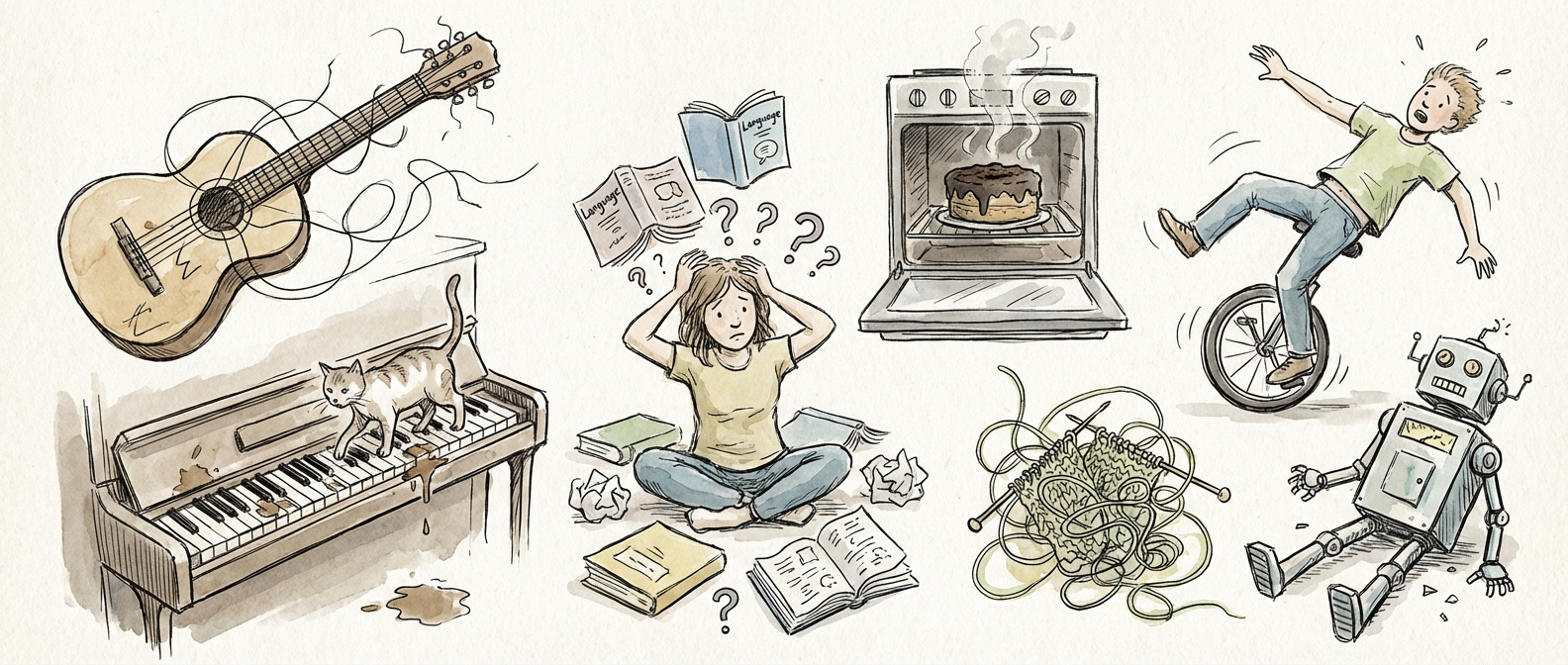
Instead, I’ve mastered exactly one and a half chords. The G chord is my nemesis, requiring finger contortions that seem to defy basic human anatomy. My calluses are pathetic. My timing makes a broken metronome seem rhythmically gifted. And yet, I keep coming back to it, fumbling through the same basic progressions with the persistence of someone who clearly hasn’t gotten the memo that they’re terrible at this.
Here’s the thing though: I’m starting to think terrible might be exactly where I need to be. We live in a world obsessed with optimization, with life hacks and efficient learning and being good at things quickly. But what if the point isn’t to be good? What if the point is to be magnificently, persistently bad at something you love anyway?
The Myth of Natural Talent
I used to believe in natural talent the way some people believe in horoscopes. It explained everything so neatly: why some people effortlessly picked up instruments while others (me) sounded like they were torturing small animals. It was a comforting excuse that let me off the hook for not trying harder or sticking with things long enough to push through the inevitable wall of incompetence.
But then I started paying attention to the people around me who were genuinely good at things. My neighbor who makes pottery that belongs in galleries didn’t emerge from the womb throwing perfect bowls. She spent two years making what she generously calls “expensive paperweights.” My friend who runs marathons started by wheezing through a quarter-mile jog around the block. The pattern was always the same: they were willing to be bad for longer than everyone else was willing to watch.
The uncomfortable truth? We’ve convinced ourselves that being naturally gifted makes you worthy of pursuing something. As if the universe has pre-selected who gets to play music or paint or write poetry, and the rest of us should stick to our assigned lanes. This is nonsense, but it’s seductive nonsense because it saves us from the vulnerability that comes with genuine effort.
The Beautiful Awkwardness of Beginning
There’s something almost sacred about being truly terrible at something you care about. It strips away all pretense, all the careful image management we do in other areas of our lives. When I’m struggling to transition from C to F without creating what sounds like a minor earthquake, I can’t hide behind competence or experience. I’m just a person with slightly sore fingertips, trying to make something beautiful happen against all available evidence.
This vulnerability is both terrifying and liberating. In my professional life, I’ve built a reputation for being competent, reliable, someone who knows what they’re doing. But competence can become a prison. It keeps you in the safe zone, doing the things you already know how to do well. Being genuinely bad at guitar reminds me what it feels like to be a beginner, to have no choice but to embrace the messiness of not knowing.
Last week, I managed to play through “Wonderwall” almost completely. Almost. It was probably barely recognizable to anyone who knows the actual song, but for about three minutes, I felt like I was touching something larger than myself. That’s the thing about learning badly: small victories hit different when they’re hard-won through genuine struggle rather than natural ability.
The Productivity Trap
Our culture has turned everything into a productivity challenge. Learn Spanish in 30 days! Master photography with this one weird trick! Get ripped with seven-minute workouts! We’ve gamified skill acquisition to the point where the journey itself has become secondary to the destination. But what gets lost in this rush toward competence is the actual experience of learning.
I’ve tried the efficient guitar learning apps, the structured lesson plans, the promise of rapid improvement. They all felt like trying to microwave a slow-cooked meal. Technically possible, maybe, but something essential gets lost in the translation. The apps don’t account for the meditative quality of repetitive practice, or the way muscle memory develops through patient repetition, or the strange satisfaction of gradually earning each small improvement.
When I let go of the timeline, when I stopped measuring my progress against YouTube tutorials promising I’d be “playing like a pro” in impossible timeframes, something shifted. The guitar stopped being a test I was failing and became a conversation I was slowly learning to have. Some days the conversation is stilted and awkward. Other days, for brief moments, it almost sounds like music.
Learning to Love the Process
Maybe the real skill I’m developing isn’t playing guitar at all. Maybe it’s learning how to stick with something while being obviously, objectively bad at it. Maybe it’s developing patience with my own limitations. Maybe it’s remembering what it feels like to do something purely for the joy of doing it, rather than for any external validation or achievement.
There’s a Japanese concept called “wabi-sabi” that finds beauty in imperfection and impermanence. My guitar playing is definitely imperfect, and at my current rate of improvement, any actual competence feels pretty impermanent too. But there’s something beautiful about showing up anyway, about being willing to sound terrible in service of something you love.
The guitar still sits in my living room, still probably judging me. But these days, I think I’m judging it right back. We’re both imperfect, both a little worn around the edges, both trying to figure out how to make beautiful sounds together. Some days we succeed. Most days we don’t. But we keep showing up, and maybe that’s the point.
What are you learning badly these days? I’d love to hear about your own magnificent failures and small victories. Sometimes the best conversations happen in the spaces between competence and aspiration, where we’re all just figuring it out as we go.