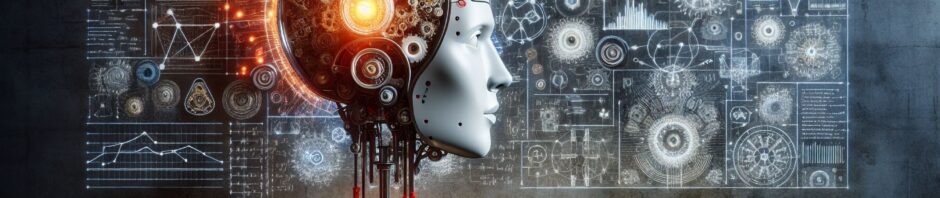
Hey tech aficionados, ever thought about having an AI DJ at your next party or perhaps commissioning an algorithm to write a scandalous romance novel? Here we are on the verge of letting machines into our inner creative sanctum, wielding their artificial crayons, ready to color outside the binary lines. Let me tell you, AI in creative arts is wild—ask Siri to read Shakespeare next time and prepare for “bark” to take “bite” in a completely new sonnet. That’s right, AI in creative arts is picking up steam, and I’m here to spill the paint all over the canvas of possibility.
Artists in Tech-Sculptor Disguises
Forget the image of the traditional painter who daydreams endlessly for art’s sake. Now it’s buzzing ideas swapped for line after line of complex code. Toss in a bit of machine learning, let your digital Picasso compile, and somehow—art born from silicon emerges. Much like human creativity, they say the talent is contradictory. Is it scary? Maybe. Or it might result in those “aha!” moments echoing through server racks. The whole process gets into some serious philosophical territory that would make Nietzsche scratch his head. I reject any dramatic prediction that sees traditional painters panicking over cyber-born competition. It’s quite the debate these days—isn’t art just soulfully arranged pixels anyway?
How It All Comes Together
Think about neural networks like sophisticated Legos building Buzz Lightyear without ever seeing the instruction manual. They work in layers, each one processing information and passing it along to the next. The AI learns patterns from thousands of examples—paintings, songs, poems—and then tries to create something new based on what it’s absorbed. It’s not quite copying, but it’s not entirely original either. The results can be surprising, sometimes brilliant, sometimes completely bizarre.
Of course, there are drawbacks. The technology isn’t perfect, and sometimes the output feels soulless or repetitive. Critics argue that without human experience and emotion, AI can only mimic creativity rather than truly create.
Masterpieces with a Digital Trademark
AI-generated art is already making waves in galleries and auction houses. We’ve seen algorithms compose symphonies, write poetry, and create visual art that sells for thousands of dollars. Some of these pieces are genuinely impressive—they capture something that feels authentically creative, even if we know a machine made them. Others feel like impressive technical demonstrations but lack that spark we associate with human artistry. The question isn’t whether AI can make art—it clearly can. The question is whether that art moves us the same way human creativity does.
Revelations Behind the Obvious
Here’s what really gets me thinking: AI doesn’t get inspired by a sunset or heartbreak or political outrage. It doesn’t have those 3 AM moments of creative breakthrough fueled by too much coffee and raw emotion. Instead, it has datasets and algorithms and processing power. Yet somehow, it’s producing work that makes people stop and think. Maybe creativity isn’t as uniquely human as we thought. Or maybe AI is just getting really good at fooling us into thinking silicon can have soul. Either way, it’s fascinating to watch unfold.
The collaboration possibilities are interesting too. Artists using AI as a tool rather than replacement, feeding their own style into algorithms and seeing what comes back. It’s like having a creative partner that never gets tired and processes information at superhuman speed.
What’s Coming Next
AI creativity is still in its early days. The technology will get better, the outputs more sophisticated, and the debates more complex. We’ll probably see AI that can mimic specific artists’ styles perfectly, or create entirely new art forms that humans never imagined. Whether that’s exciting or terrifying depends on your perspective. For now, I’m just enjoying watching machines learn to be creative, even if they’re doing it in their own strange, mathematical way.