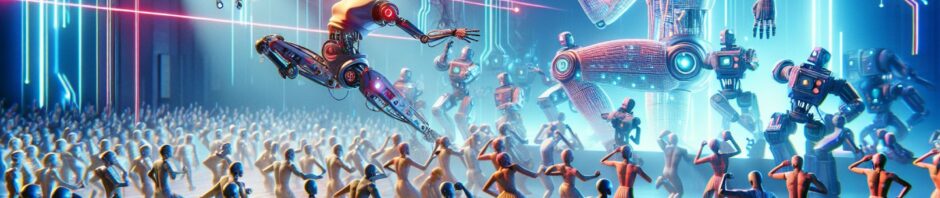
Hey there, tech enthusiasts! Grab a comfy seat and pour some fresh coffee; you’re gonna want to settle in for this. Today, we’re diving into the fascinating intersection of robotics and the creative arts. No, I haven’t binge-watched too much sci-fi or suddenly embraced a world where breakdancing robots captain starships, but reality has gotten absolutely wild with machines pirouetting into the world of creative expression.
A Sketch of Artistic Geometry
Picture this: a group of agile robots, painted in bold colors, gliding across the stage in perfect sync to the beat of the music. If this sounds like someone’s fever dream, I promise you it’s not. Robot choreographers are now breaking into the creative sector, proving they can do more than assemble car parts. They’re creating genuinely moving artistic experiences.
Companies like Boston Dynamics aren’t just impressing us with their viral videos of robot gymnastics. They’ve started collaborating with artists and creatives, pushing boundaries Thomas Edison never could have imagined. It’s wild, really. These massive robots, originally built for industrial tasks, are now learning rhythm. They’re teaching us about movement and grace, one 360-degree spin at a time.
New Platforms for Playwrights and Composers
Why stop at dance? Some brilliant minds are developing frameworks that let artists, composers, and playwrights experiment without the usual constraints. Imagine staging a three-act play where you never worry about missed cues because your entire cast is wirelessly connected to the same timing system.
One project worth mentioning is RoboDrama, a collaboration between AI researchers and forward-thinking theater artists. They’re working toward interactive performances where robots can improvise responses and adapt storylines in real-time. The technology isn’t quite there yet for full improvisation, but the early experiments are genuinely intriguing.
What’s really exciting is how this opens up new creative possibilities. Artists can test ideas that would be impossible or prohibitively expensive with human performers.
Moving into Algorithmic Music
Then there’s music that composes itself. Before you start worrying about Matrix-style scenarios, let me explain what’s actually happening. Musicians and programmers are creating systems that can generate melodies, harmonies, and even entire compositions based on various inputs and parameters.
I’ve heard some of these algorithmic compositions, and honestly? Some are surprisingly good. Others sound exactly like what you’d expect from a computer trying to make music. The interesting part is when human musicians collaborate with these systems, using them as creative partners rather than replacements.
These tools aren’t replacing human creativity. They’re expanding it. A composer can feed the system a basic melody and get back dozens of variations to work with. It’s like having a tireless creative partner who never runs out of ideas, even if some of those ideas are completely ridiculous.
A Glimpse into Tomorrow’s Potential
Where does this all lead? I’m honestly not sure, and I think that uncertainty is part of what makes it exciting. We’re seeing the early stages of machines that can participate in creative processes, not just execute predetermined tasks.
Will robots ever truly create art the way humans do? That’s probably the wrong question. They’re creating something different, something that emerges from the intersection of human creativity and machine capability. And frankly, I’m curious to see where that takes us.
The real magic happens when artists stop trying to make robots act like humans and start exploring what robots can do that humans can’t. Perfect synchronization across dozens of performers. Compositions that evolve in real-time based on audience reactions. Movement patterns that would be impossible for human bodies.
It’s early days still, but I’m genuinely excited about where this intersection of technology and creativity might lead us. Just don’t expect me to start taking dance lessons from a robot anytime soon.